
Part of the preparation to perform this ritual involves making a headband that includes a symbol. In both the Preisendanz and Betz editions of the Greek Magical Papyri, the symbol is rendered something like ‘ :> ‘. Based on a closer look at the original papyrus I’d like to speculate that perhaps we have been looking at the wrong symbol on line 172 and propose alternative possibilities
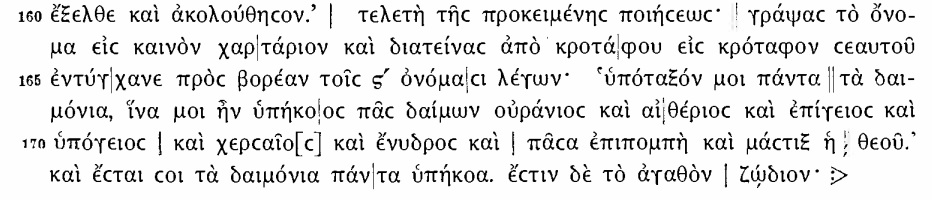
Preisendanz, Karl, ed. and trans. Papyri Graecae Magicae: Die griechischen Zauberpapyri. 3 vols. (Leipzig: Teubner, 1928–1941)
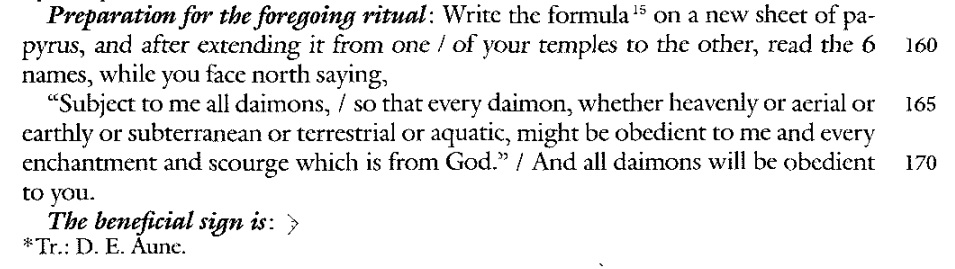
Betz, Hans Dieter. The Greek Magical Papyri in Translation, including the Demotic Spells, Vol.1., 2nd edition, ed. Hans Dieter Betz (Chicago: University of Chicago Press, 1997)
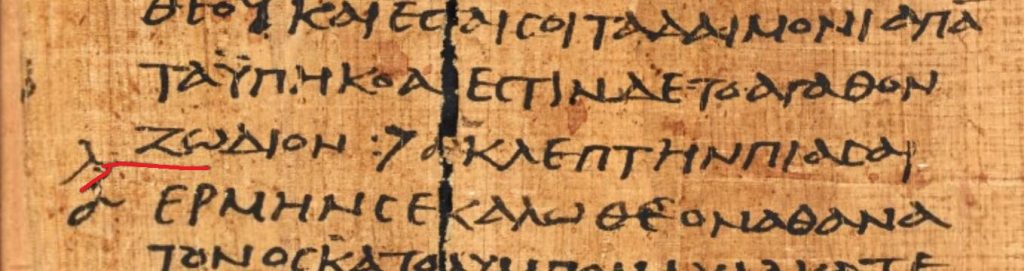
If we look at the British Library’s scan of the original, we can see that there is a symbol in the margin that is not being represented in the most well-known translations of the papyri.
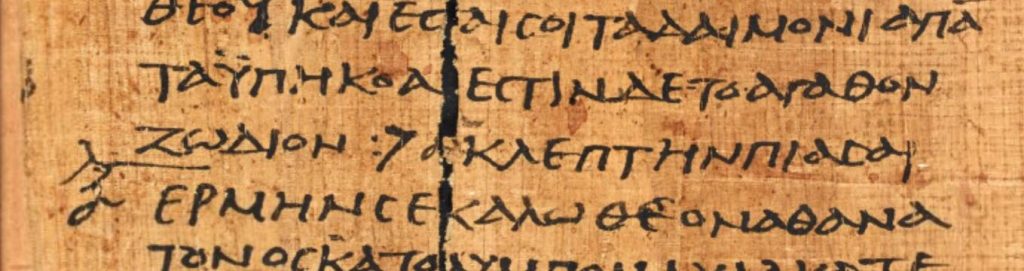
The last word of this spell is ζῴδιον, which can mean either a small figure or sign of the zodiac. After that we see the ‘:>’ symbol, and the very next word is the start of a new spell.
What if the symbol between the end of one spell and the beginning of another, is a scribal notation to keep them separated, and the symbol for the headband is the one depicted in the margin? With this in mind, I’ve tried to identify the new symbol. It is my belief that the identity of the symbol in the margin has been elusive because it’s actually several symbols. Let me walk you through my research so far.
Comparison with the rest of PGM V
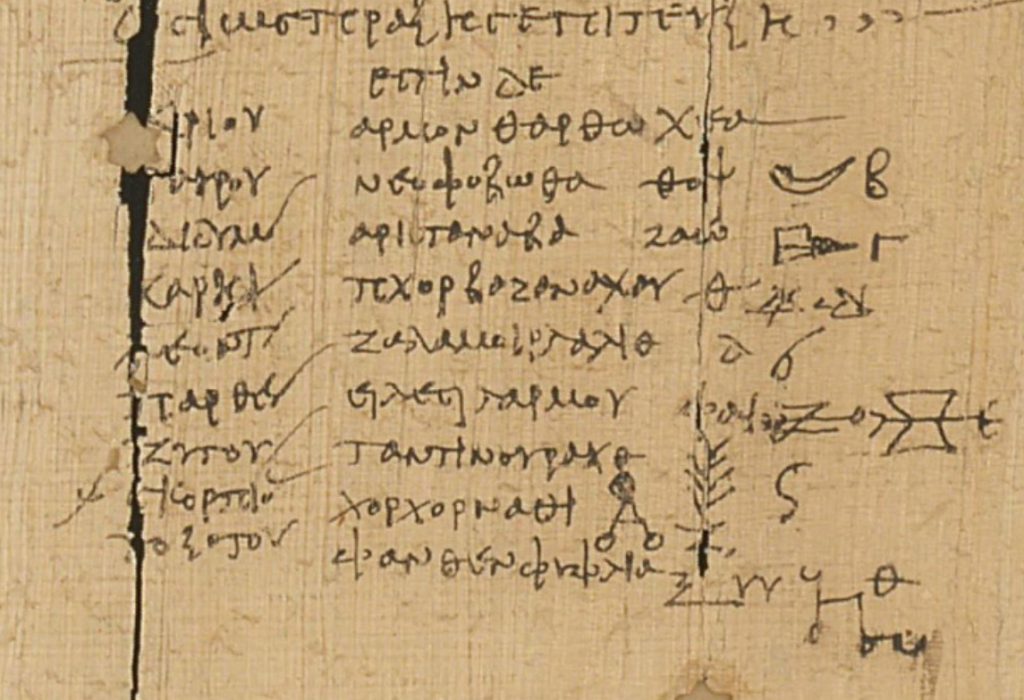
First, I looked at the rest of the papyri for matching symbols. At the beginning of the spell, we see a two-stroke line separating PGM V. 70-95 and PGM V. 96-172:
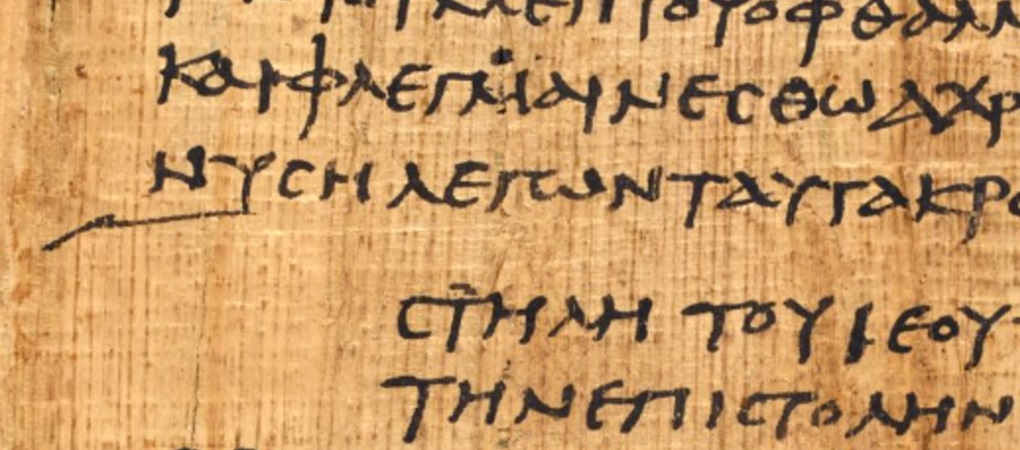
We also see that earlier in the papyri on lines 69-70:
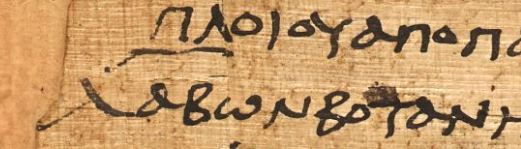
I am assuming that two strokes of the symbol on line 72 are a scribal separation as well and have marked the matching lines in red below.
Comparison with Greek Paleography
Looking closely at the margin symbol, I spotted what appeared to be two dots, like a colon:
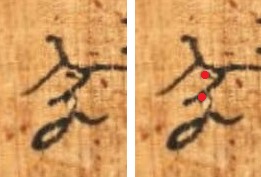
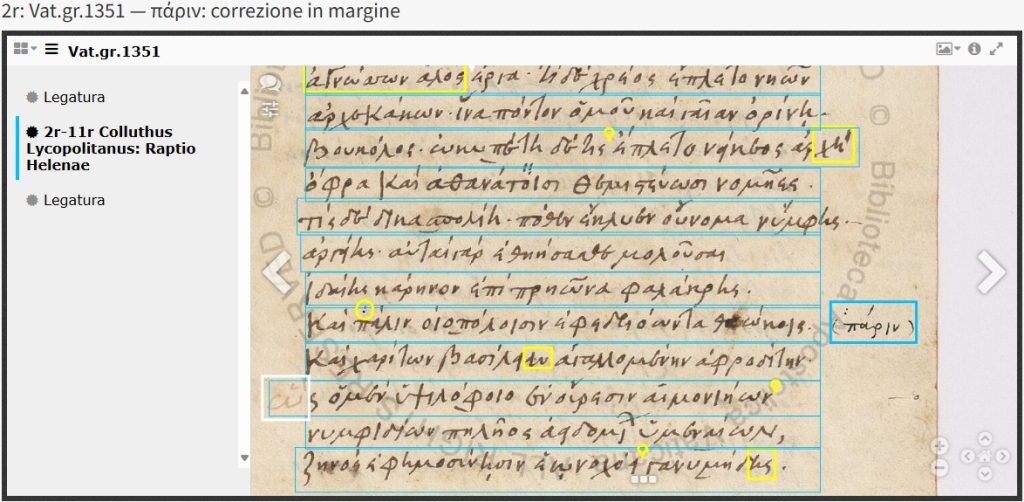
I cross referenced Greek Paleography From Antiquity to the Renaissance [by T. Janz] which is an online reference hosted by the Vatican Library. This matches a type of scribal annotation we see in another, much later Greek manuscript, occurring several times where a colon in the text references a notation in the margin, and it denotes a correction by a different scribe (due to the handwriting).
If anyone reading this has a citation for similar scribal marks in a Greek or Egyptian document closer to the Roman era, please let me know.
If we remove the colon and the two lines that make up the divider, we are left with what seems like two characters. I have drawn over the lines I am removing in red in the picture below.
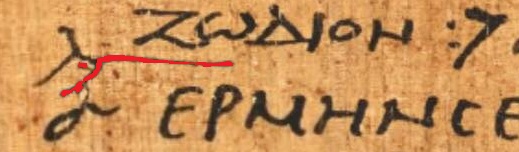
I had previously spent a lot of time looking at Greek scribal ligatures because they occur elsewhere in PGM V. A ligature is a combination of letters into a single symbol, like Æ. While there is by no means an exhaustive catalogue of the many Greek scribal ligatures, I reviewed my sources and they felt off track, though the PGM certainly contains many other examples of ligatures. If you would like to check them out for yourself for this or other research, I have found “The Ligatures of Early Printed Greek” by William H. Ingram to be very useful. https://grbs.library.duke.edu/article/download/11391/4169
If it was Greek it could be a λ and an α. However, we have a lot of examples of λ and α in PGM V and none are similar.
Comparison with PGM Zodiac symbols
It didn’t match any of the zodiac symbols listed in PGM VII which is also from that time period of Thebes.
Comparison with Hieratic
I was compelled to check out Hieratic, which was a sort of scribal shorthand that preceded Demotic. In “A Very Brief Introduction to Hieratic” by Joshua Aaron Roberson (2018) he reminds us that “…it is incumbent upon the student to bear in mind that Hieratic is handwriting and handwriting is variable. The “standard” sign forms that appear in the palaeographies are merely representative examples. In
practice, signs will vary from these “standards” to a greater or lesser degree, depending on the time period and the preferences of the individual scribe. Greater awareness and recognition of the gestalten allows us to filter out the noise created by these variables and zero-in on the underlying information that the scribe sought to encode.”
There is a very real possibility that this text was copied by someone who was not the original author and they didn’t understand the marginalia. If that is what happened the figures may be sloppy. With the first figure, it seems like the little line coming from the top is intentional, and the bottom forks. The second figure looks a lot like the Hieratic eye to me.


Möller, G. “Hieratische Paläographie I-III, 2e éd.” Otto Zeller, Osnabrück (1909). Via the Hieratische Paläographie DB at https://moeller.jinsha.tsukuba.ac.jp/
If it was Hieratic the first figure could be a sloppy wꜣs scepter 𓌀 and the second figure could be an ir eye 𓁹. That would make it 𓌀𓁹 Wsir or Osiris, as his name was written in Greco-Roman Thebes*
By posting this and showing how I investigated the symbols, I hope to inspire others to do their own research. I also hope that someone more familiar with Hieratic, or Theben papyri from the Roman era will weigh in.
Please let me know what you think in the comments, especially if you test the spell with a new set up symbols inspired by this post.
* updated to cite Klotz, David. Kneph: The Religion of Roman Thebes. Yale University, 2008. p. 270 for that spelling of Osiris.
12/2/25 Update
It’s all Greek to Me
I reached out to Chris Cogger for an opinion on this blog and the response strongly shifted my opinion in favor of the marginalia symbols being an α and λ. I am reposting those comments with permission.
Chris: “I doubt it’s hieratic or demotic, personally. The marginalia is consistent with the other Greek unical paragrapha in the rest of the papyrus and others around Thebes. You’re right the material for the stele ends with the :7 sign (ζωδιον just means form, and can refer to 2D or 3D imagery, they use it for everything), but the next word is αλ with another λ in superscript. It’s hard to see because the papyrus is cut at the point, but grammatically its the only thing I can see that makes sense.”
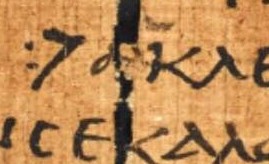
Chris: “The next word is κλεπτὴην πιασαι (to lay hold of/catch a thief). The αλ(λ) is a standard abbreviation in the papyri that just means “next/another”, and signals the next spell. To me, the marginalia to the left seems to be another αλ, just with the lambda extended to signal the next spell. There isn’t a colon, I don’t think, that bottom dot is part of the α, there’s just a hole in the papyrus that splits it up. Klotz its right that wꜣst.ir can be a spelling for Osiris around Thebes, but its more commonly 𓋆𓋴𓂋𓀭 (lit. the strong/victorious), and by the time pgm v was composed/redacted, knowledge of hieratic was pretty lacklustre, most were using demotic (see https://www.ames.ox.ac.uk/demotic), or depending how far south you go, Meroitic, which would have been 𐦠𐦯𐦣𐦫𐦢.”
Alison: “Thank you SO MUCH for weighing in. I think you are right about the marginalia. So does that bring us back to the ζοδιον being :> ?”
Chris: “Ι think so, the αλ is a contraction of (καὶ) ἄλ(λους) which means “and others”, and is used commonly to introduce new spells of the same genre/style. The demotic equivalent is kt, which abbreviates pḫrt. What it seems happened is that the Ieou inscription/stele got inserted in between a collection of thief spells (i.e PGM V 70-95 and 172-212), maybe from a separately circulating manuscript. The context is weird, στηλη probably means inscription in this context, and there’s no letter alluded to in the spell, so it’s not clear what επιστολην refers to, unless “Ieou” (whoever he was, if anyone) included it as part of a personal letter to the redactor, which does sometimes happen (moreso in PGM I and the PCM though)”
Chris: “For all we know though, the redactor might have just forgot to include the actual figure and :> is just a placeholder or scribal sign that we don’t recognise. It could also be some very botched version of a demotic sign or even Meroitic.”
Find Chris on YouTube at: https://www.youtube.com/@mystai/videos

Author: Alison Chicosky
Alison Chicosky is a scholar and practitioner of a variety of forms of thaumaturgy with a focus on results-based magic. While especially interested in both Solomonic magic and the Graeco-Egyptian magic of the Greek Magical Papyri, she is also well versed in soul-flight and psychic magic of various kinds. The founder and force behind Practical Occult (www.practicaloccult.com), she strives to provide pentacles and other enchanted items drawn from a broad background of rigorously studied ancient arts, leveraging the systems of the past for practical modern use.