
Sometimes an Animal is Just an Animal
Recently a friend who knows I have been studying the medical magic of Antiquity asked if I had an ancient spell to heal a tooth. I did have an example spell, but it included instructions to put a specific type of animal excrement in your mouth or substitute a specific body part of a lizard. I am being vague because no one should test this spell. Seriously, this is how we get plagues.
We laughed about it and then I made a humorous post on social media about ancient sorcery and animal parts. That post was immediately flooded with people saying that animal parts in historical magic were referring to botanicals.
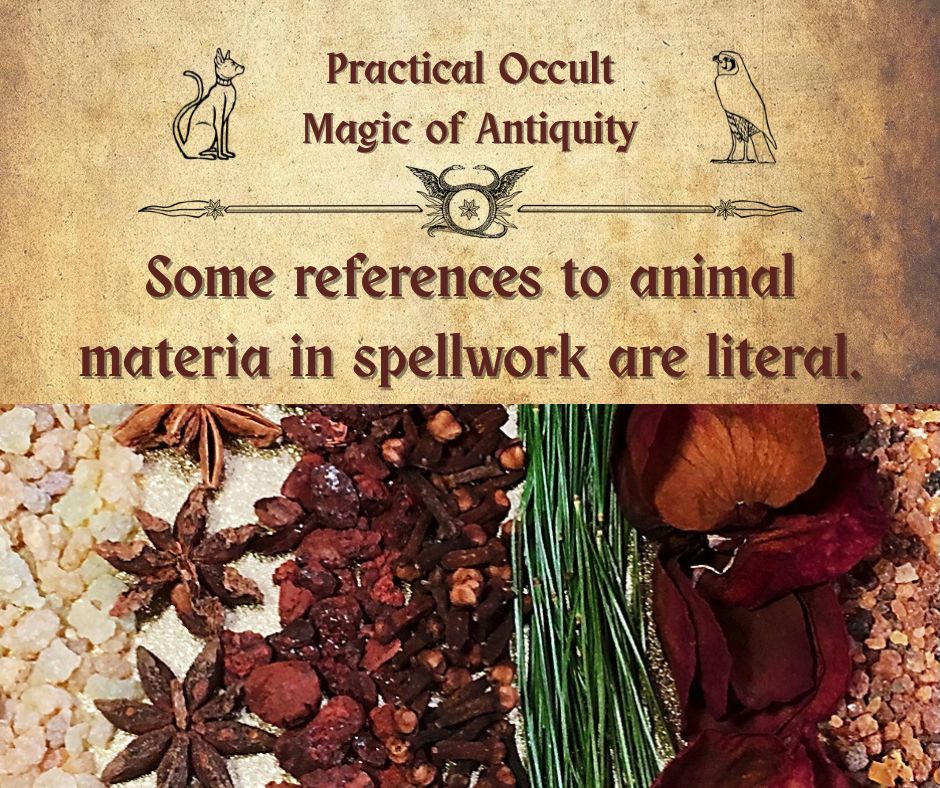
The historical truth is that sometimes they were referring to plants but other times they really did mean animals. This requires case by case discernment.
Did The Practitioners of Antiquity use Blinds?
A blind in this case refers to the practice of an author intentionally changing some information for the purpose of concealment. We don’t have to wonder if they did, it has been attested. PGM XII. 401-44 states outright that this was happening. The rest of the text goes on to provide a key to a long list of these blinds.
PGM XII. 401-44
*Interpretations which the temple scribes employed, from the holy writings, in translation. Because of the curiosity of the masses they [i.e., the scribes] inscribed the names of the herbs and other things which they employed on the statues of the gods, so that they [i.e., the masses], since they do not take precaution, I might not practice magic, [being prevented] by the consequence of their misunderstanding.”
It’s worth noting that per this text, some of the ingredients were blinds for non-botanical ingredients. Examples include:
- A snake’s head: a leech
- Blood of a Hamadryas baboon: blood of a spotted gecko
- Lion semen: Human semen
- A bull’s semen: egg of a blister beetle
In addition to intentional blinds, many plants were just called by their folk names in formularies. Those folk names sometimes sound like animal parts. My grandmother used to grow cock’s comb (celosia) in her garden. It gets the name because the red variants are somewhat reminiscent of the comb of a rooster.
Did Some Spells Really Refer to Animals?
Yes, it is common in magic to use animals or parts of animals as materia. The texts of the PGM infamously call for the use of both entire animals and parts of animals. In some cases the animal had to be killed in a certain way or maimed and released alive. Those instructions could only refer to actual animals, rather than alternate names for plants.
How To Tell the Difference
Figuring out if the spell’s author meant what they said or if they are using a blind is complicated and may not always be possible with scholarship alone. I have listed part of another PGM spell as an example. I am not listing the entire spell. Please DO NOT attempt this spell.
PGM XXXVI. 231-55 *Take a lead lamella and inscribe with a bronze stylus the following names and the figure, and after smearing it with blood from a bat, roll up the lamella in the usual fashion. Cut open a frog and put it into its stomach. After stitching it up with Anubian thread and a bronze needle, hang it up on a reed from your property by means of hairs from the tip of the tail of a black ox, at the east of the property near the rising of the sun.”
This curse spell calls for the blood of a bat. There is certainly precedent for using bats in curses, like in PGM IV. 2943-66 which calls for the eyes of a bat and then specifies that the creature be released alive. If the instructions call for releasing it alive, it surely means an animal part. However, in the aforementioned list of PGM XII. 401-44 “blood of” ingredients can refer to vegetable, mineral, or another animal. This could go either way.
The frog in this spell surely means a frog. The use of frogs and toads in magic may be a trope, but it is a trope because of their persistent use in the history of magic in many cultures. This spell ties the curse to the frog- “…just as this frog drips with blood and dries up, so also will the body of him…” with the dessication of the frog being inflicted on the curse’s target.
Hairs from the tip of an ox’s tail could have been a blind, but probably weren’t. They are being used to hang this lamella ( thin metal sheet) so the materia would have been string-like. Additionally it would have been easy to acquire due to the prevalence of oxen in farming at the time.
The questions I ask to determine the ingredients include:
- Is there additional historical context that points to one interpretation over another?
- Does the context of this spell support a literal reading?
- The memory spell of PGM I. 232-47 lists a recipe for magical ink. Along with myrrh, wormwood, pine cones, figs, and dates the spell calls for “7 wings of the Hermaic ibis.” Though ibises are used in magic elsewhere in the PGM, I took the 7 wings to be another name for plant materia, in this case buckthorn, as per a reference in PGM XII. 401-44.
- How obtainable would the materia have been?
- For example, it is unsurprising when the PGM lists “lion semen” as a blind because how would someone in antiquity obtain that? I mean….think about it.
What Now?
I know many folks like myself have been exploring the magic of antiquity to see which magic is still viable and practical. People frequently ask me what I do when I see spells calling for rare ingredients, especially animal materia. Sometimes I am able to obtain uncommon materia through my connections, like the tanned skin of a stillborn donkey, and it allows me to try to get a baseline of what a spell looks like when done by the book. While I am enthusiastic about experimental archeology, I am more enthusiastic about practical magic. A spell that requires a rare ingredient is not practical. Additionally we often see many spells for the same purpose so I just pick a different spell.
I think your personal answer is going to depend on your motivations. Are you more interested in reconstructing rituals or are you more interested in practical techniques? Either way, I’d love to hear about your efforts and results.

Author: Alison Chicosky
Alison Chicosky is a scholar and practitioner of a variety of forms of thaumaturgy with a focus on results-based magic. While especially interested in both Solomonic magic and the Graeco-Egyptian magic of the Greek Magical Papyri, she is also well versed in soul-flight and psychic magic of various kinds. The founder and force behind Practical Occult (www.practicaloccult.com), she strives to provide pentacles and other enchanted items drawn from a broad background of rigorously studied ancient arts, leveraging the systems of the past for practical modern use.